

Teaching, Learning & the NGSS
MothEd’s curricular materials are thoughtfully designed to balance engaging student experiences with practical classroom implementation. Our activities position students to take ownership of their learning as they explore the fascinating world of moths through inquiry and investigation. Wherever possible, we explicitly reference relevant NGSS performance expectations, helping teachers align their instruction with national science standards through authentic, hands-on learning.
The MothEd Approach to Teaching and Learning
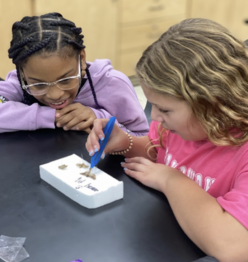
At the heart of MothEd is a commitment to student-centered, inquiry-driven science education. We believe that students learn science best not by memorizing facts, but by doing science—asking questions, designing experiments, collecting data, and interpreting and communicating results. MothEd supports teachers in creating a classroom environment where students are positioned as investigators who engage directly with the natural world around them.
This Teacher Guide is built on principles of active learning and ambitious science teaching, where students collaboratively construct understanding through observation, discussion, and iteration. We recognize teachers as expert facilitators who bring their own creativity and contextual knowledge to the implementation of MothEd. Our modular design encourages flexibility—teachers can adapt materials, reorder modules, extend investigations, or invent brand new activities to align with the unique needs of their students and communities.
By combining hands-on ecological research with collaborative digital tools like CLUE, MothEd invites students to see themselves as contributors to scientific knowledge. This approach nurtures curiosity, fosters scientific reasoning, and builds confidence in learners of all ages and backgrounds.
For School Leaders & Administrators
MothEd offers more than just a science unit—it’s a model for ambitious, standards-informed, inquiry-based instruction that meets the needs of today’s classrooms.
The MothEd Teacher Guide focuses on:
- Student engagement in core disciplinary ideas and science and engineering practices.
- Crosscutting concepts like patterns, cause and effect, and systems thinking
- Real-world data collection and interpretation.
- Integration of environmental literacy and engineering design.
Whether your district follows NGSS or another framework, MothEd provides meaningful learning experiences that align with 21st-century science education goals. It’s designed to be flexible, adaptable across grade levels, and supportive of teacher creativity and contextual needs.
MothEd is also technology-ready. Our Collaborative Learning User Environment (CLUE) enables students to work in teams, analyze data, and publish their findings—building digital literacy alongside scientific reasoning.
If you’re looking to expand student-centered learning and foster authentic engagement with science and nature, MothEd is a ready-to-use, research-informed solution that teachers love and students remember.
Middle School NGSS Standards Addressed in the MothEd Teacher Guide
Standard – MS-LS1-4: Use argument based on empirical evidence and scientific reasoning to support an explanation for how characteristic animal behaviors and specialized plant structures affect the probability of successful reproduction of animals and plants respectively.
Featured in Lessons:
- All About Moths!
- Build a Trap!
- Designing Experiments & Forming Hypotheses
- Trapping!
- Sorting & Pinning
- Graph It!
———-
Standard – MS-LS1-5: Construct a scientific explanation based on evidence for how environmental and genetic factors influence the growth of organisms.
Featured in Lessons:
- Designing Experiments & Forming Hypotheses
- Sorting & Pinning
———-
Standard – MS-LS1-6: Construct a scientific explanation based on evidence for the role of photosynthesis in the cycling of matter and flow of energy into and out of organisms.
Featured in Lesson:
- Designing Experiments & Forming Hypotheses
———-
Standard – MS-LS2-1: Analyze and interpret data to provide evidence for the effects of resource availability on organisms and populations of organisms in an ecosystem
Featured in Lessons:
- All About Moths!
- Insect Ethics
- Build a Trap!
- Designing Experiments & Forming Hypotheses
- Trapping!
- Sorting & Pinning
- Return of the Hypothesis
- Share It!
———-
Standard – MS-LS2-2: Construct an explanation that predicts patterns of interactions among organisms across multiple ecosystems.
Featured in Lessons:
- All About Moths!
- Insect Ethics
- Designing Experiments & Forming Hypotheses
———-
Standard – MS-LS2-3: Develop a model to describe the cycling of matter and flow of energy among living and nonliving parts of an ecosystem.
Featured in Lesson:
- Trapping!
———-
Standard – MS-LS2-4: Construct an argument supported by empirical evidence that changes to physical or biological components of an ecosystem affect populations.
Featured in Lesson:
- All About Moths!
- Build a Trap!
- Designing Experiments & Forming Hypotheses
- Sorting & Pinning
- Return of the Hypothesis
———-
Standard – MS-LS4-4: Construct an explanation based on evidence that describes how genetic variations of traits in a population increase some individuals’ probability of surviving and reproducing in a specific environment.
Featured in Lesson:
- All About Moths!
———-
Standard – MS-ESS3-3: Apply scientific principles to design a method for monitoring and minimizing a human impact on the environment.
Featured in Lessons:
- All About Moths!
- Insect Ethics
- Designing Experiments & Forming Hypotheses
———-
Standard – MS-ETS1-1: Define the criteria and constraints of a design problem with sufficient precision to ensure a successful solution, taking into account relevant scientific principles and potential impacts on people and the natural environment.
Found in Lessons:
- Insect Ethics
- Build a Trap!
- Designing Experiments & Forming Hypotheses
———-
Standard – MS-ETS1-2: Evaluate competing design solutions using a systematic process to determine how well they meet the criteria and constraints of a problem.
Found in Lesson:
- Build a Trap!
———-
Standard – MS-ETS1-3: Analyze data from tests to determine similarities and differences among several design solutions to identify the best characteristics of each that can be combined into a new solution to better meet the criteria for success.
Found in Lessons:
- Build a Trap!
- Sorting & Pinning
———-
Standard – MS-ETS1-1: Develop a model to generate data for iterative testing and modification of a proposed object, tool, or process such that an optimal design can be achieved.
Found in Lessons:
- Designing Experiments & Forming Hypotheses
- Sorting & Pinning
- Return of the Hypothesis
- Present It!