
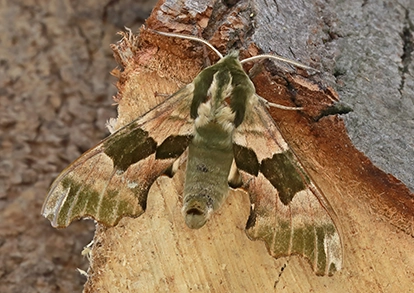
The Teacher Guide Act 1: Planning and Introduction
The first two phases in the MothEd teacher guide are focused on preparing the teacher for implementation and introducing the students to the wonderful world of moths.
Phase 1: Plan
The Plan phase provides an overview of the MothEd curriculum and supports teachers in deciding how best to integrate the unit into the scope and sequence of their existing curriculum. There are no explicit lessons or student-facing materials during this phase as teachers prepare for the unit.
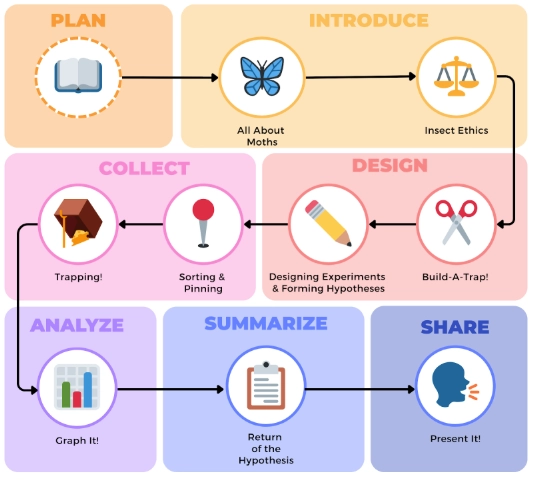
Phase 2: Introduce
LESSON 1: All About Moths!
The first lesson in this phase, All About Moths!, introduces students to the world of moths, providing engaging facts and interactive activities to spark curiosity and wonder. This introductory lesson lays the groundwork for deeper exploration in later lessons, helping students build both scientific knowledge and an appreciation for moth ecology.
Learning Outcomes:
By the end of this lesson, students will be able to:
- Describe the general anatomy of moths.
- Outline the ways that moths impact humans as pollinators, pests, and components of the terrestrial food web.
- Describe the life cycle of a moth.
- Pose interesting questions about moths and their local neighborhoods.
Activities:
Some of the activities in this lesson include:
- Using a slideshow, teachers catalog and uncover what their students already know about moths.
- A discussion activity where driving questions are used to stimulate thought on what the students already know about moths, and what they might want to learn or discover.
- Students complete a “Just the Facts” or “Fact or Cap” game-like activity, which highlights what students already know about moths, and where their knowledge gaps may lie.
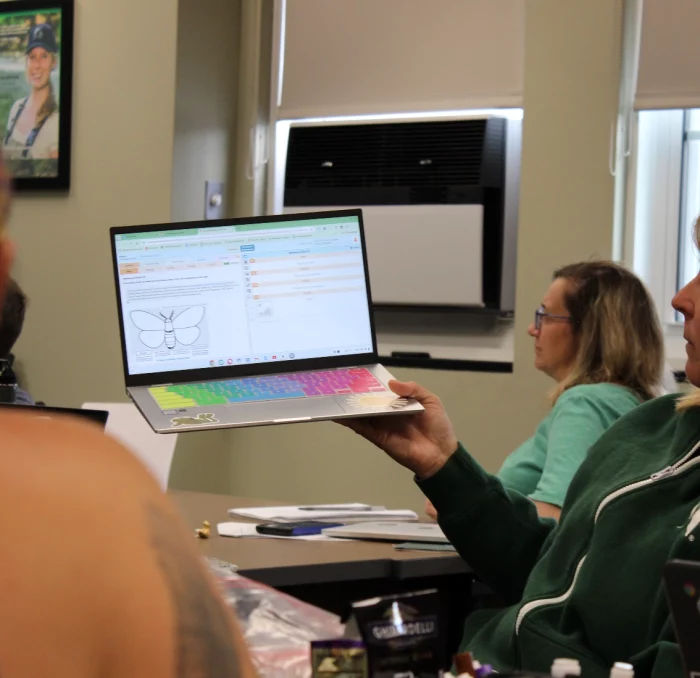
- Students use one of three grade-appropriate worksheets – a coloring page, a cut-and-assemble activity, or a “design-a-moth” exercise – to explore moth anatomy.
- Students continue to build foundational knowledge and learn about the moth life cycle using a worksheet, including metamorphosis, and the ways that moths interact with humans.
- Students start to situate what they now know about moths into a local context. They use a worksheet to critically consider how moths might function in the habitats around their neighborhoods, homes, and in nearby natural areas.
———-
LESSON 2: Insect Ethics
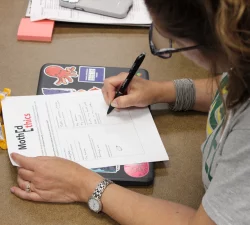
The second lesson in this phase, Insect Ethics, engages students in discussions about the ethics of killing insects in educational, scientific, and everyday contexts. This lesson helps navigate potential negative attitudes toward euthanizing moths and insects for ecological research.
Learning Outcomes:
By the end of this lesson, students will be able to:
- Engage in thoughtful situations–specific discussions about the appropriateness of killing insects.
- Apply ethical reasoning to real-world scientific practices.
Activities:
Some of the activities in this lesson include:
Students collaboratively create a decision tree to define criteria for when insect killing is considered ethically justifiable.
Students critically examine the ethical considerations involved in killing insects for scientific study.
Students complete an ethics worksheet to assist them in evaluating real-world insect-killing scenarios and articulating their reasoning behind when it is acceptable to kill insects.